
How to Check for a Warrant in Graham County
Graham County posts no sheriff warrant roster. No local database gathers them either. A full warrant check therefore runs on several tracks: the statewide Arizona DPS search, the court that could have issued the warrant, the sheriff's records channel, and direct calls to the municipal or Justice Court. Pull out any citation, complaint, appearance letter, or case paper first. The issuing court's name matters more than the town where someone lives. Gather the full legal name, date of birth, case or citation number, and any former name in the file. Never act on a same-name match alone. Graham County shares names like anywhere else. If an active warrant seems likely, a licensed Arizona attorney can advise on appearance, surrender, bond, and motions before any contact with law enforcement.
- Search Arizona DPS with first name, last name, and date of birth.
- Call the court named in a result and ask for current status.
- Check Gila Valley Consolidated Municipal Court for Safford, Thatcher, or Pima matters and Graham County Justice Court for county or state officer cases.
- Use the Sheriff's Office public-record request or main line when a law-enforcement record, service, or custody answer is needed.
- Ask the issuing court what action will resolve the warrant, and consult counsel before surrender or bond decisions.
Graham County Warrant Search Fields
For a Graham County warrant search with the widest reach, begin with the Arizona DPS Warrant Search. Three identity fields are required before the lookup runs. DPS caps its display at five records. It may also repeat a warrant number when one order carries several charges, so treat the output as a lead and confirm anything through the court listed.
| Field | How to enter it | Why it matters |
|---|---|---|
| First name | Use the legal spelling tied to the case | Reduces weak partial matches |
| Last name | Include the current case surname | Pairs the record with the person |
| Date of birth | Use the full month, day, and year | Separates people with similar names |
The official interface and its caution text appear in the assigned image.
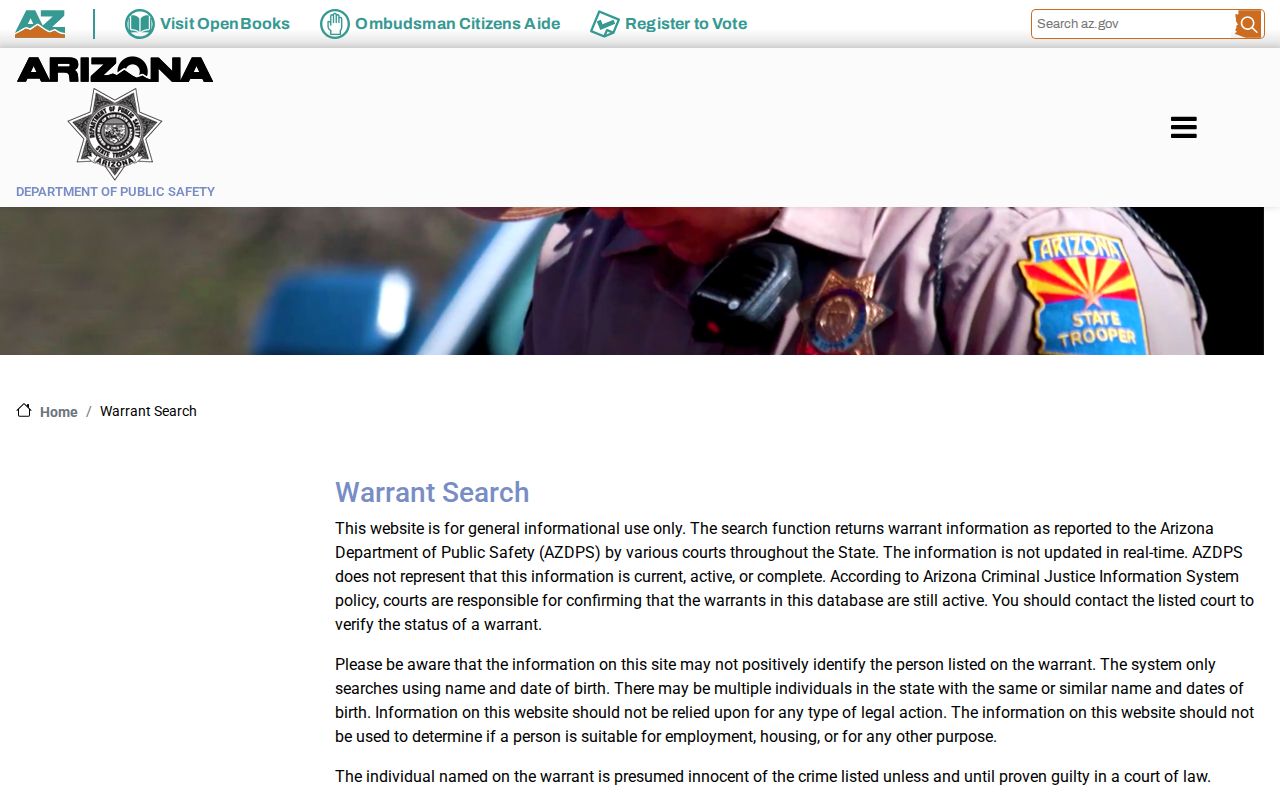
Exact identity data matter. A Graham County result names a court, and only that court can confirm the warrant's status.
Types of Warrants in Graham County
Arizona courts, including those serving Graham County, issue different warrants for different jobs. An arrest warrant lets police take a person into custody once a judge finds probable cause. A bench warrant works differently. Courts issue it after a missed appearance or a broken order. Miss court over a ticket and a traffic failure-to-appear warrant can follow through the municipal or Justice Court process. A search warrant stands apart, authorizing a search of a place or property under its own access rules.
| Warrant type | How it arises | Who issues it |
|---|---|---|
| Arrest warrant | Probable cause supports taking a person into custody | Superior, Justice, or Municipal Court judge within jurisdiction |
| Bench warrant | Missed setting or failure to comply with an order | The judge managing the case |
| Search warrant | Sworn facts support a search for evidence | A judicial officer under Arizona law |
| Traffic or FTA warrant | Required traffic response or appearance was missed | GVC or Graham County Justice Court |
No Graham County source labels its routine orders capias or capias pro fine. Locally, expect bench warrant, arrest warrant, and failure to appear.
Graham County Warrant Court Map
A warrant question in Graham County can land at three different desks. The Superior Court of Arizona in Graham County handles felony trials and other general-jurisdiction matters. Graham County Justice Court takes county or state officer traffic and misdemeanor cases, plus felony initial appearances and preliminary hearings. GVC covers city or town traffic, misdemeanor, petty-offense, and ordinance matters for Safford, Thatcher, and Pima. The official Graham County Courts and Judicial page lays out this courthouse structure.
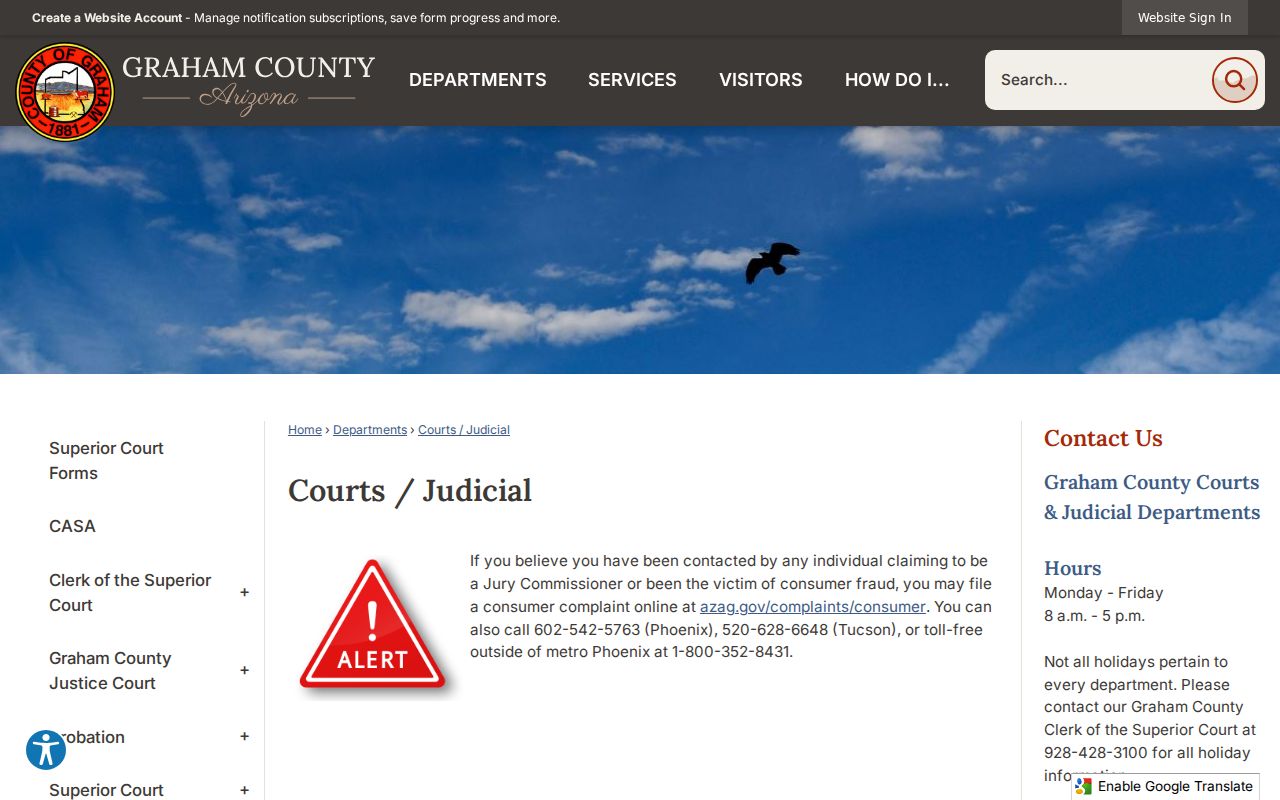
Find the right jurisdiction before asking about warrant status. The Clerk of the Superior Court cannot resolve a GVC bench warrant, and a municipal clerk has no say over a Superior Court felony order.
What a Graham County Warrant Record Shows
No official source publishes a single Graham County warrant-number format. Read any result as a cluster of matching facts. The warrant or case number ties an order to its docket. The court field tells you where to confirm. The charge is an allegation only. A bond figure can change or may not apply to every route, and status deserves extra care, since an online system can lag behind a judge's action.
| Warrant or case number | The court's file identifier; preserve it exactly as shown, such as legacy prefix S-0502-CR. |
|---|---|
| Subject name and DOB | Identity facts used to avoid relying on a same-name match. |
| Charge or offense | The alleged conduct and case type attached to the order. |
| Issuing court | The judicial office with authority to confirm or change status. |
| Bond or amount | A listed term that requires current confirmation before payment. |
| Status | Active, served, recalled, quashed, or cleared, as verified by the court. |
Graham County Public Access Limits
Arizona Public Access helps with case leads from participating courts, but it demands a verification step and warns that updates arrive weekly. Some courts and case types sit outside it, and it is not the official court record. The bigger limit comes from Arizona Supreme Court Rule 123, which excludes warrants and bench warrants from broad remote public access. A case entry can exist while the warrant itself stays hidden. The Arizona Public Access case lookup shows those constraints on its face.
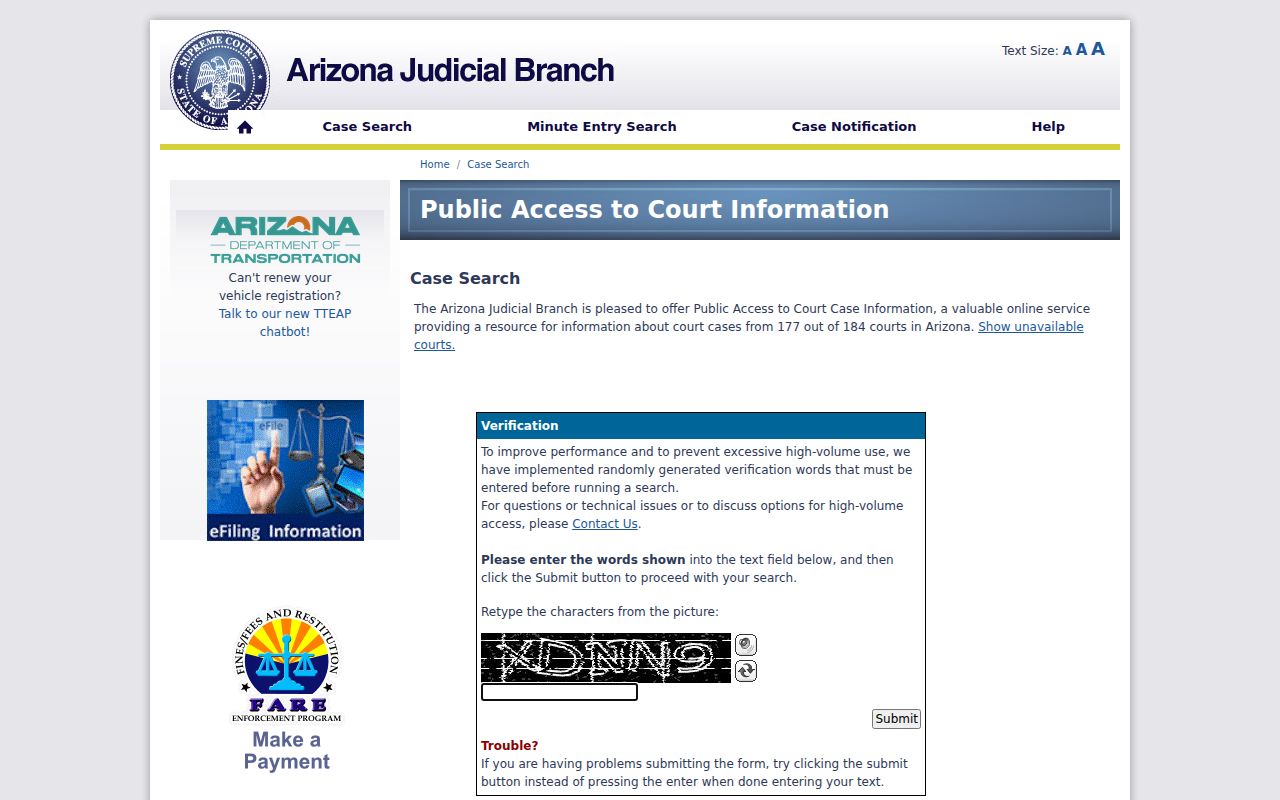
A glitchy search result proves nothing. If Graham County's portal stalls or an entry is missing, write down the court and case number, then call that court to confirm whether a warrant is truly open.
Who Issues and Serves Graham County Warrants
Graham County judges issue warrants from the Superior, Justice, and GVC Municipal courts, each within its own jurisdiction. Serving the papers is a different job. The sheriff's office, Safford Police, Thatcher Police, Pima Police, and other authorized officers can execute an arrest order. But service never moves control of the case; the issuing judge still decides recall, quash, bond, and the next hearing.
Warrant flow: issuing court › sheriff or police service › detention or appearance › issuing court resolution
Adult Detention
600 W. Graham Canal Road
Safford, AZ 85546
928-428-2455
Open 24 hours for detention operations
The Graham County Sheriff's public-records counter is open Monday through Thursday, 7 a.m. to 6 p.m. There is no separate warrant-unit line or public roster.
No Graham County Sheriff Warrant Roster
No online sheriff roster, so work the channels in order. That gap does not mean Graham County has no active warrants. Start with the issuing court, then the sheriff's main and records lines, Arizona DPS, and the court case systems. City cases need a direct GVC check, since they may not sit where a county-level search expects.
A no-result is not clearance. DPS says its records are not real-time, current, active, or complete, and the issuing court must verify status.
Graham County works on paper requests. The sheriff's noncommercial request form asks whether you want inspection or a copy, and your purpose for asking. Processing can take up to 10 days, the form warns. Superior Court material goes through that court's own request form, and the office will contact you within five business days to confirm fees. Neither route confirms a warrant on the spot. Both are document requests, not an instant warrant check for Graham County.
What to Do If You Have a Graham County Warrant
Never sit on a confirmed Graham County warrant. Paying an old balance will not necessarily recall it. Call the issuing court and ask whether the order is active, whether an appearance is required, what bond applies, and whether counsel can appear. A lawyer can also explain voluntary surrender, a motion to recall or quash, and your bond choices. A recall or quash is the judge canceling the warrant as an active arrest order.
Important: Speak with an Arizona lawyer before surrender or bond decisions, and confirm every instruction through the issuing court's official number.
During business hours, the court can explain its own process for a Graham County warrant. After hours, Adult Detention accepts cash only for bond, per the county's jail guidance, and other jail transactions follow money-order rules. Do not arrive with an assumed amount. Ask the court or detention staff what payment is authorized. Keep your receipts, the next setting, and written proof of any recall. An online payment confirmation alone does not show that the judge lifted the warrant.
Thatcher Graham County Warrant Window
Thatcher offers one unusually specific local option. Its municipal-court page sets a walk-in warrant window. Anyone with an outstanding Thatcher Municipal Court warrant may appear on Wednesday from 1:30 p.m. to 4 p.m. to speak with the judge, who will quash the order and work to resolve the case. Call GVC at 928-432-4090 first. Schedules and eligibility change. Ask what to bring, from identification and citation to appearance letter, receipts, proof of compliance, and an accepted payment method. The window covers qualifying Thatcher municipal matters only. Not every Graham County warrant qualifies. Graham County Justice Court and Superior Court orders must follow their own issuing court's process. GVC also arranges interpreter and ADA accommodations, and its form asks for advance notice when possible.
Public Access to Graham County Warrant Records
Arizona public-records law generally supports inspection and copying. Limits still apply in Graham County. The office holding a record may withhold sealed, juvenile, or other nonpublic material. Search-warrant records have their own timing rule and stay nonpublic until return, unless a court changes that. Remote access to court records is also narrower than what a clerk's counter can provide.
Key rules:
A.R.S. § 39-121 provides a general right to inspect public records during office hours.
Arizona Supreme Court Rule 123 governs judicial records and excludes warrants from broad remote access.
A.R.S. § 8-208 limits access to juvenile material.
A.R.S. § 13-3918 controls when search-warrant records become public.
Ask for the specific record, office by office. In Graham County, a sheriff report request, a Superior Court docket request, and a GVC status check are separate acts.
Graham County Superior Warrant Documents
Arizona eAccess provides document access for participating Superior Court records. Fees and restrictions apply. Sealed or confidential material stays out, and restricted warrant files do not become open web pages there. A docket clue may surface, but you would still need the Clerk of the Superior Court to identify the official record and its current status in Graham County. The official Arizona Superior Court eAccess service is the access point.
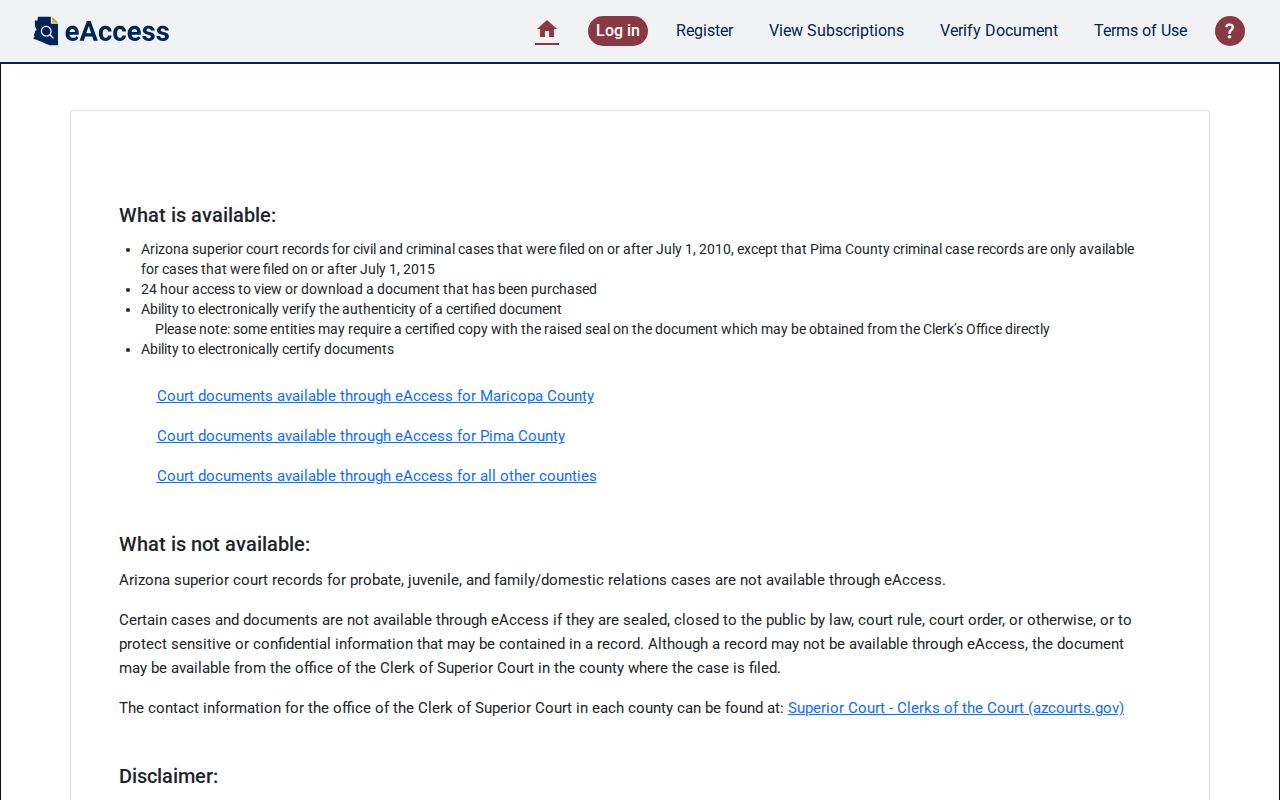
That is not a public warrant roster. The notice treats electronic document access that way, and Graham County Justice Court's 2026 eFiling implementation is filing modernization, not a new warrant-search launch.
Graham County Warrant Terms
Plain words help at the counter. Similar terms can point to different events in a Graham County file, and only the court can say which one applies.
- Active or outstanding
- The issuing court still treats the warrant as open; confirm it on the day action is planned.
- Bench warrant
- A judge's arrest mechanism commonly tied to a missed appearance or violation of an order.
- Arrest warrant
- A judicial order based on probable cause that authorizes taking a person into custody.
- Quash or recall
- The judge cancels the warrant as an active order, often while the underlying case continues.
- Bond forfeiture
- Loss of posted bond after a required appearance or condition is missed.
- TTEAP
- An Arizona traffic-debt registration-hold program, not a warrant search.
GVC's current traffic notice warns that a missed appearance can bring added penalties, bond forfeiture, suspension effects, or a warrant in Graham County. Each outcome is different.
Warrant Records by City in Graham County
Three incorporated places make up Graham County's municipal-court system. Safford, Thatcher, and Pima share GVC Municipal Court at 702 S. 8th Avenue in Safford. City police can cite, investigate, arrest, and serve orders, while GVC keeps the municipal case and confirms its warrant status. Each city route differs, so check the city-specific details.
Safford Warrant Records
10,129 people in the 2020 Census · Safford Police FAQ directs warrant questions to GVC and the other issuing courts.
Thatcher Warrant Records
5,231 people in the 2020 Census · Thatcher publishes the Wednesday municipal-warrant judge window and a limited citation-search route.
Pima Warrant Records
2,847 people in the 2020 Census · Pima's former magistrate function was consolidated into GVC in January 2018.
Graham County has no fourth or fifth incorporated city with its own municipal-court profile. The list stops at three. No unincorporated community is added.
Verify Graham County Warrant Calls
In October 2024 the Graham County Sheriff's Office warned about fake jury-duty warrant calls. The caller claims a warrant exists. Then comes a demand for Bitcoin or another payment to remove it. Hang up, find the court or agency number on its official website, and place a fresh call yourself. No legitimate Graham agency clears a warrant through an unsolicited payment demand. Never share card, bank, wallet, or account details. Save any message without responding. Report the attempt to the sheriff or local police. A real court record can be checked with GVC, Justice Court, Superior Court, or DPS as appropriate. GrahamTIP is an anonymous public-safety tip route, not a most-wanted list or warrant database, and it never replaces direct court confirmation of your own case.